Trusted Worldwide | 250+ Cities Designed | 5 Million + Premises Connected

Reading Time: 2 minutes
Why Proper Grounding Matters in Fiber Network Design and Integration
Project Overview
When it comes to fiber network deployment, the focus is often on speed, bandwidth, and technology. But beneath the surface literally lies one of the most overlooked aspects of network design: grounding.
At NetPMD, where we design and integrate networks across entire cities, we know that getting grounding right isn’t just good practice; it’s what keeps networks reliable, safe, and operational long after construction wraps up.
Why Grounding Matters
Grounding rarely makes it into project photos or press releases. Yet when a lightning strike, power fault, or surge hits, it’s grounding that decides whether your network keeps running or fails catastrophically.
Without a solid ground path, electrical energy looks for its own route to the earth. Sometimes that route runs through equipment… or people. A properly bonded and tested ground ensures that energy safely exits the system, protecting your field engineers, your infrastructure, and your customers.
The Risks of Getting It Wrong
Poor grounding doesn’t just cause downtime; it causes damage. We’ve seen cases where ungrounded cabinets led to fried power supplies, unstable signal performance, or safety hazards during maintenance.
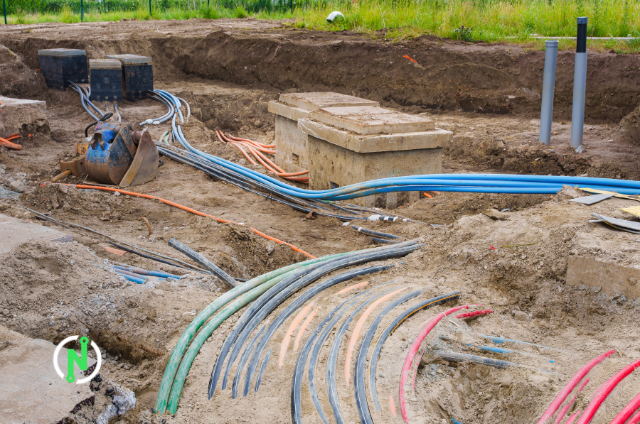
Fiber operators working underground often assume that buried infrastructure is automatically protected. It isn’t. Soil type, moisture content, and local voltage variations can all create dangerous potential differences between assets. One missed bond, one rod in dry fill, and the whole protection system can fail.
What “Done Right” Looks Like
At NetPMD, our teams treat grounding as a core design principle, not an afterthought.
Proper grounding means:
- – Selecting real, conductive soil that maintains contact year-round.
- – Ensuring clean, continuous bonding from cabinet to conduit to earth rod.
- – Testing and validating resistance before backfilling.
Once it’s done right, it just works. You never hear about it again—and that’s exactly the point.
Grounding and the Bigger Picture
In large-scale fiber builds, every small detail contributes to the overall performance and safety of the network. Grounding ties directly into the reliability goals of every project.
For network operators, municipalities, and engineering firms, this means:
- – Fewer outages and service calls.
- – Longer equipment life and better ROI.
- – Improved safety compliance for field teams.
Grounding might not be glamorous, but it’s the difference between a network that performs on day one and one that performs for years.
NetPMD’s Approach
As an independent fiber design and integration partner, NetPMD delivers end-to-end solutions that cover every technical detail, grounding included. From feasibility to turn-up, our focus is on quality, reliability, and safety.
We make sure every connection is tested, every cabinet is protected, and every project is delivered right the first time. Because in our world, the best work is the work you never have to redo.
Building a fiber network that lasts starts from the ground up.
If you’re planning a fiber rollout or looking to improve network reliability, partner with a team that doesn’t overlook the details.
Talk to NetPMD about designing and integrating your next fiber network project.
Recent Posts
 The 58,000-Role Problem Facing US Fiber Deployment
March 4, 2026
 Another Year of Growth, Delivery & Partnerships
December 18, 2025
