Trusted Worldwide | 250+ Cities Designed | 5 Million + Premises Connected

Reading Time: 3 minutes

Milwaukee Data Center Migration
Executive Summary
This case study outlines the successful relocation of the Milwaukee Data Center in Wisconsin, IL. The project involved detailed planning, network impact assessment, engineering preparation, and the coordinated migration of key Nokia routing and optical platforms. Through structured project management and comprehensive engineering execution, the migration was completed within the approved maintenance window and without major service disruption.
Background
The Milwaukee Data Center serves as a regional hub supporting mobile traffic, backhaul transport, and management plane connectivity. Due to infrastructure changes and evolving operational requirements, a relocation of all active equipment and services was required. This initiative aimed to ensure long term network reliability, minimize risk, and align the facility with current design standards.
The Challenge
The primary challenge was to migrate all active network equipment including IP edge routers, management routers, and optical backhaul nodes while ensuring minimal impact to customer traffic. The migration required:
- – Precise analysis of traffic and impacted services
- – Coordination across multiple engineering and operations teams
- – Physical relocation of live network elements
- – Strict execution within a 6-hour downtime window
Reliability and accuracy were critical, as the Data Center supports a large number of cell sites and ISP interconnects.
Project Management Approach
A structured project management framework was implemented to ensure clarity, accountability, and risk mitigation:
- – Task Breakdown: All activities were itemized and documented.
- – Ownership Assignment: Every task was assigned a specific action owner to avoid ambiguity.
- – Weekly Progress Tracking: Recurring meetings were established to monitor deadlines and resolve blockers.
- – Risk Identification: Potential risks including fiber readiness, node failover behavior, and downtime overruns were documented early.
- – Risk Mitigation: Contingency plans were designed, including redundant path testing and pre-migration validation of all fibers and connections.
This structured approach ensured cross team alignment and readiness ahead of the migration window.
Engineering Scope
The migration involved relocating and re-commissioning the following platforms:
- – Nokia 7750 SR-1s – IP Edge Router
- – Nokia 7705 SAR-X – Management Router
- – Nokia 1830 PSS-16II – DWDM Optical Backhaul Node
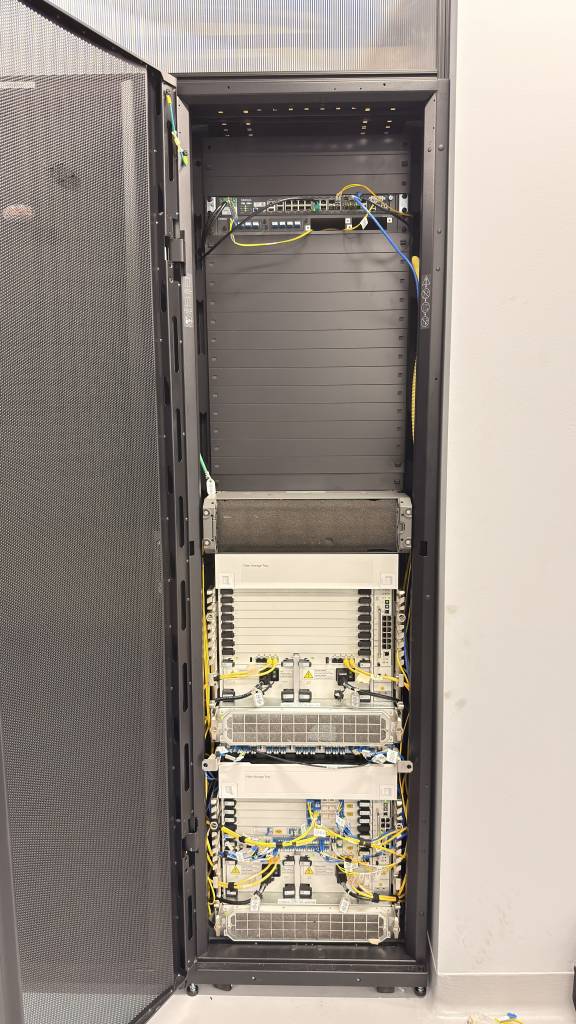
The existing layout utilized two ETSI racks with an associated fiber patch panel. Engineering activities included end-to-end assessment of logical, optical, and physical interfaces.
Analysis Phase
A comprehensive analysis was conducted prior to any physical activity:
- – Service Impact Identification: All cell sites and ISP connections dependent on the Milwaukee DC were mapped and analyzed.
- – Traffic Impact Assessment: A full traffic study was performed to determine peak loads and understand migration risk.
- – Network Resiliency Testing: Failover tests confirmed the presence of redundant routing paths to maintain service continuity.
This phase ensured clear visibility of operational risk and dependency mapping.
Preparation
Extensive pre-implementation work ensured the migration would proceed smoothly:
- – Identification of all active connections and termination points
- – Development of new rack layouts
- – Creation of full port mapping documentation for the migration
- – Backups of all nodes and adjustments to neighbor interfaces
- – Physical site inspections and relabeling of connections
- – Testing of new fiber paths and patch panels
- – OTDR testing across all inter-fiber connections
- – Preparation and approval of a detailed MOP (Method of Procedure)
- – Securing a 6-hour maintenance window
By completing these tasks prior to migration, the team minimized uncertainty and avoided on-site delays.
Implementation
The migration was executed in a controlled and sequenced manner:
Infrastructure Readiness
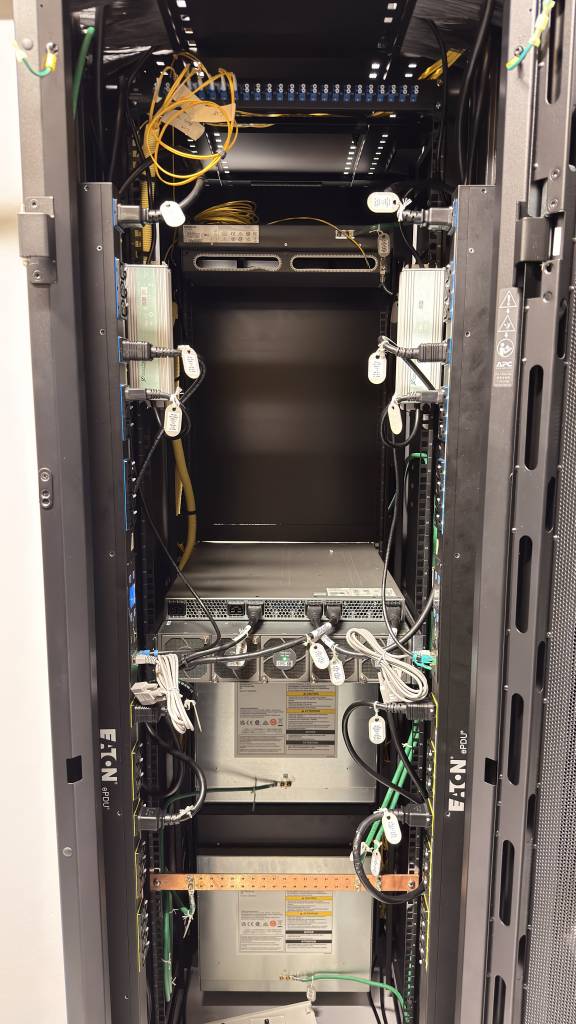
- – Installation, grounding, and power-up of the new rack
- – Verification of the new fiber patch panel and connectivity
Migration Execution
- – Controlled power-down of all equipment within the migration window
- – Decommissioning and isolation of power feeds
- – Physical relocation and re-installation of all nodes following the new rack design
- – Re-termination of power and fiber connections
- – Node bring-up and configuration according to the approved MOP
- – Validation of routing, optical sessions, and management paths
The migration was completed within the approved window, with post-migration health checks confirming stable service operation.
Results
- – Successful relocation of all active DC infrastructure
- – Zero major service outages outside the approved maintenance window
- – Improved cable management and rack design
- – Updated documentation supporting long-term operational efficiency
Lessons Learned
- – Adequate time must be allocated for fiber scoping and cleaning to prevent last-minute delays.
- – All optical and patch panel connections should be tested and validated before entering the migration window.
Recent Posts
 The 58,000-Role Problem Facing US Fiber Deployment
March 4, 2026

